


monitoring industrial elections
The environmental monitoring system, designed for industrial enterprises and environmental laboratories, is designed and manufactured according to the requirements of each Customer
At the same time, we guarantee full compliance with the requirements:
Environmental Code of the Republic of Kazakhstan dated January 2, 2021 № 400-VI
Federal Law "On Environmental Protection" of January 10, 2002 N 7-FZ
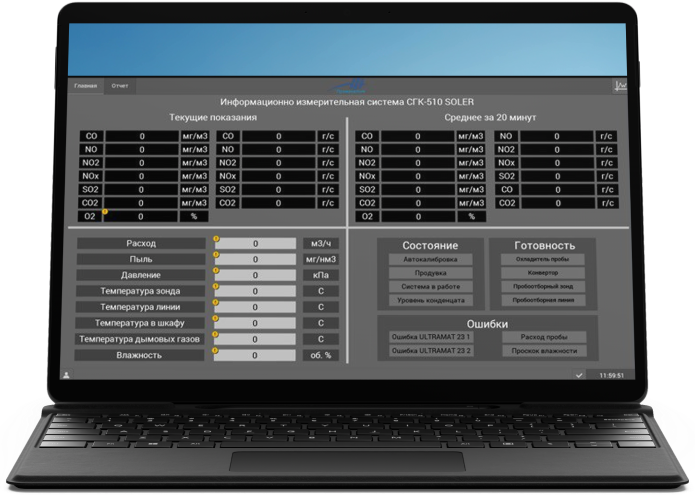
Automated wastewater monitoring systems
An automated wastewater monitoring system (AWMS) is a set of measuring equipment and software designed for continuous monitoring of wastewater flow rate and physicochemical parameters. The system records measurement results, stores them, and flags instances where monitored values exceed established limits.
There is no standard configuration for such systems. The set of measuring equipment is determined individually for each facility, taking into account the discharge point, the characteristics of the wastewater, and the list of parameters that need to be monitored. The AMS consists of flow meters, sensors, and analyzers, data acquisition equipment, software, and an operator workstation.
Wastewater Monitoring Requirements in Kazakhstan
The primary regulatory document is the Rules for Operating an Automated System for Monitoring Emissions into the Environment During Industrial Environmental Monitoring. These rules were approved by Order No. 208 of the Minister of Ecology, Geology, and Natural Resources of the Republic of Kazakhstan dated June 22, 2021.
Paragraph 17 of the Rules applies to wastewater discharges from Category I facilities discharged into surface water bodies or onto the ground. An exception is provided for evaporation ponds and storage ponds. For such discharges, the automated system must monitor five parameters:
- temperature;
- flow rate;
- pH;
- electrical conductivity;
- turbidity (EMF turbidity units based on formazine per liter).
These requirements establish the mandatory minimum. If a company needs to monitor additional parameters, these are taken into account during project design and the selection of measuring equipment.
How does automated monitoring differ from laboratory testing?
Automated monitoring systems and laboratory testing serve different purposes. An automated monitoring system continuously records parameters for which appropriate measuring instruments are installed at the facility. Laboratory monitoring is based on sampling and allows for the determination of parameters that are not included in automatic measurements. Therefore, the installation of an automated monitoring system does not mean a complete abandonment of laboratory monitoring if it is provided for in the industrial environmental monitoring program.
What wastewater parameters does the automated system monitor?
Temperature, flow rate, pH, electrical conductivity, and turbidity—these are the basic parameters for discharges subject to automated monitoring requirements in Kazakhstan. Technically, the capabilities of the automated monitoring system are broader: the range of measurements can be expanded by installing the appropriate sensors and analyzers.
|
Category of Measured Indicators |
Controlled Parameters |
|---|---|
|
Hydrological and Physical |
Volume flow rate, level, temperature |
|
Basic Physical and Chemical Properties |
pH, electrical conductivity, turbidity, total suspended solids (TSS) |
|
Organic Pollution Indicators |
Chemical Oxygen Demand (COD), Biochemical Oxygen Demand (BOD), petroleum products, dissolved oxygen |
|
Biogenic elements and ions |
Ammonium nitrogen (NH₄⁺), nitrates (NO₃⁻), chlorides, dissolved salts |
Not all of the listed parameters need to be measured in every production run. The list is determined during the design of the automated control system, and sensors, analyzers, and auxiliary equipment are then selected based on that list.
How the wastewater monitoring system works
Measurements are taken directly at the monitoring point. The flow meter measures the volume of wastewater, while sensors and analyzers measure the specified physical and chemical parameters. The information is then transmitted to the data collection system and to the operator’s automated workstation.
Current values can be viewed on the workstation, and measurement results are stored in the archive. Thus, the operator receives not individual sample results, but data on how the monitored parameters change over time. The system automatically records any values that exceed the specified limits.
The “Potok” automated monitoring system is designed to transmit data via the RS-485 interface and the OPC protocol. This allows the equipment to be integrated into the facility’s existing automation system and to transmit information to a SCADA system or a process control system.
A key consideration during design is selecting the correct location and method for flow measurement. The equipment is selected based on the actual conditions at the outlet and the type of pipeline or channel.
Where Are Automated Wastewater Monitoring Systems Used?
First and foremost, automated monitoring is required at facilities where such monitoring is mandated by environmental regulations. These systems are installed at industrial plants, wastewater treatment plants, power generation facilities, and other sites that discharge wastewater.
However, regulatory compliance is not the only purpose of automated monitoring systems. Continuous measurements provide the enterprise with data for operational environmental monitoring and allow it to track changes in effluent parameters between laboratory sampling intervals. This same data can be used to monitor the operation of treatment and process equipment.
For facilities where the installation of an automated monitoring system is not required by law, the enterprise makes the decision to implement automated monitoring based on its operational needs.
Promanalit Automated Wastewater Monitoring Systems
The Promanalit catalog features solutions for measuring wastewater quality and flow rate: the “Potok 400” system, the “Potok 120” electromagnetic flowmeter, the “Potok 100” flowmeter, and the “Potok” automatic monitoring system.
There is no such thing as a “one-size-fits-all” equipment package here. First, the necessary monitoring points and parameters are determined, after which the measuring equipment and system configuration are selected.
Promanalit handles equipment selection and installation, as well as maintenance, repairs, and calibration. The company has its own calibration laboratory and service department.